
Contactless Hospitality Software Development Services
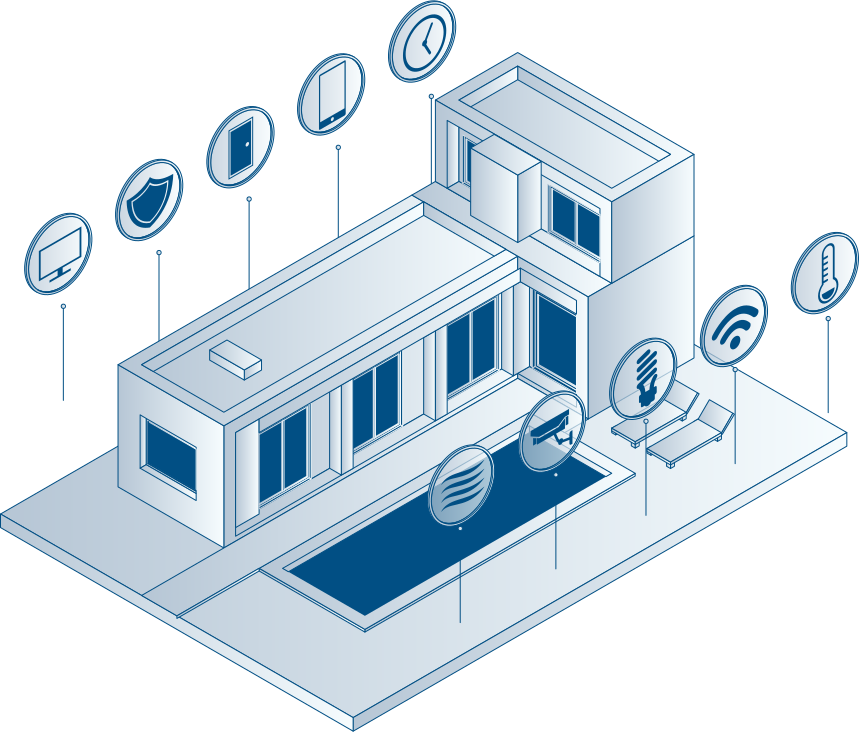
SysGears provides contactless hospitality software development services, helping HoReCa businesses of all sizes deliver personalized guest experiences via their smartphones while reducing staff workload. Build a custom mobile application to support self-check-in, keyless entry, seamless room service, digital payments, and frictionless guest communication. Offer convenience, speed, and privacy to increase loyalty and outpace your competitors.
How Contactless Technology is Transforming Hospitality
Millennial and Gen Z travelers expect swift, on-demand service, preferring mobile-first experiences with minimal in-person interaction. To keep up with this trend, HoReCa businesses are increasingly adopting contactless hospitality solutions — tools and technologies that enable guests to manage their stay independently, avoiding physical touchpoints. Contactless software, such as mobile check-in apps, self-service check-in kiosks, hotel digital key software, and virtual concierges, helps hoteliers personalize guest service, reduce wait times, improve safety, and cut operating costs.
If you are looking for a hospitality app development company, consider SysGears. Backed by extensive experience building software for customer-facing industries, we deliver fast, intuitive applications with branded UI and functionality that effectively support your guest journeys. From small projects like contactless hotel payment integration to AI-powered contactless hospitality app development, our team can help you innovate while remaining cost-efficient. We offer flexible collaboration models, including full outsourcing, assembling a dedicated team, or strengthening your in-house resources with our niche engineering expertise.
Contactless Hospitality Trends and Statistics
Only 5%
of Gen Z and Millennial travelers prefer live communication with hotel staff
41%
of guests ranked keyless entry and contactless check-in and check-out among their top-3 hotel technology requirements
49%
of the American hoteliers list AI integration among priority tech initiatives
18%
reduction in weekly hours for front-desk and housekeeping staff due to hospitality innovations
Contactless Hospitality Solutions We Develop
We build web solutions and cross-platform mobile applications for iOS and Android, ensuring fast and convenient user experiences while maximizing reach.

Ensure your hotel is equipped to provide contactless guest experiences. A property management system centralizes reservations, billing, and guest profiles, ensuring the right guest receives the right service. If your hotel’s workflows are complex and a ready-made PMS can’t meet your needs, consider building a custom solution with SysGears.

Let your guests skip front-desk lines and manage their arrival and departure directly from their smartphones. Built as either a mobile app or a web portal with no download required, a contactless check-in solution enables selecting room preferences, automated ID verification, instant payments, and issuing a digital key (if available).

Automate customer communication while leaving only complex, high-priority tasks to your reception staff. From restaurant reservations to late check-out requests, provide your guests with a virtual assistant that can help them navigate your hotel services from a single place. Besides, your hotel digital concierge software can serve as a guest-facing marketing tool, displaying relevant promotions, discounts, and upsell suggestions.

Increase in-room spending, boost F&B sales, and make your guests feel at home with contactless room service app development from SysGears. Minimize the need for phone calls and face-to-face communication by enabling your guests to order meals and request other amenities through a convenient mobile app or a web solution available via a QR code.

Enrich your guest experience with an all-in-one interface for lighting and climate control, as well as multimedia device management. Our full-stack development team can build an IoT-based application that integrates with in-room systems and is often more convenient and intuitive compared to wall panels and smart TV controls.

Build a custom AI-powered chatbot to provide instant answers to guest questions based on relevant interaction history and knowledge-base content. On top of that, create a contactless guest experience platform to handle the entire communication cycle, from pre-arrival to post-stay, across multiple channels, including WhatsApp and Messenger (Meta).
More Features to Enhance Guest Contactless Experiences

Some guests are not willing to install an app. To satisfy their needs, provide in-room QR codes for placing orders and submitting feedback via an online portal that doesn’t require downloads or user sign-up.

SysGears can integrate your custom contactless hospitality app with a digital key and access- control system installed in your hotel, allowing your guests to unlock their rooms with their smartphones.

Our team can empower your contactless hospitality solution with text-to-speech and speech-to-text capabilities, enabling faster request submission and improving accessibility.

We can connect your application to a certified payment gateway like Stripe, PayPal, or others, ensuring your guest transaction details are reliably protected.

For self-check-in, we can add a photo upload feature for ID capture and integrate a reliable e-signature tool, so your guest can sign consent forms and terms of stay.

Benefits of Contactless Hospitality Solutions Development Services

Increase Guest Autonomy
75% of Gen Z and Millennial travelers prefer hotels with self-service options. Let your guests manage their stay on their smartphones, avoid queues, and enjoy privacy — all with the help of custom contactless hospitality solutions.

Improve Communication
Some guests may find remote communication more convenient than face-to-face interactions with the staff. Offer them remote communication tools with multilingual support to minimize misunderstandings and mistakes caused by language and cultural barriers.

Drive Revenue at All Guest Touchpoints
Whether in their room, by the pool, or on their way to your hotel, enable your guests to order services with a few taps. Offer targeted upsells and cross-sells throughout the entire guest journey, increasing revenue and boosting guest experiences.

Reduce Operational Costs
By 2035, labor demand in the hospitality sector is projected to exceed supply by 16%. Mitigate staff shortage risks by automating communication, check-ins, order processing, and other manual workflows.


AI in Contactless Hospitality
Backed by extensive expertise in AI integration, RAG, and prompt engineering, SysGears can enhance your contactless hospitality application with generative AI capabilities, making guest experiences smarter and more engaging. We design prompts and retrieval workflows to manage tone and ground responses in your proprietary data to reduce the risks of false or misleading answers. Our developers ensure that your AI operates within defined policy boundaries to minimize the chance of harmful or biased outputs.

Smart Recommendations
Suggest room upgrades, dining, spa, car rentals, and other extras, with the system taking into account guest segment, service availability, and the guest journey stage. This way, you increase the chance of selling the right service to the right guest at the right time.

Fast, Personalized Communication
Provide personalized guest responses through an AI-powered chatbot that uses guest context (e.g., stay details and order history) and a tailored hotel knowledge base. Empower your guests with built-in translation tools and voice assistants to make communication more accessible.

Guest Analytics
Identify guests’ service usage patterns, group guests by their behavior and preferences, and analyze messages and post-stay reviews to identify satisfaction levels and escalate if needed. With AI assisting these tasks, you can make more informed decisions and provide more targeted service.

Ready-Made vs. Custom Contactless Hospitality Software

Off-the-Shelf Contactless Hospitality Application
Fits well when:
- Your hotel operations align with the features offered by a SaaS solution.
- You don’t require functionality beyond the scope of the out-of-the-box app.
- You don’t need customization and integration with legacy systems.
- You want to launch a contactless service as soon as possible.
Risks:
- You remain dependent on the vendor’s roadmap and pricing policy.
- Licensing fees often increase as more modules are added, and the number of rooms and transactions grows.
- Some features may not be relevant to your operations, and some may be missing, causing manual workarounds.

Custom Contactless Hospitality Application
Fits well when you:
- You have complex, unique guest workflows that off-the-shelf solutions can’t accommodate.
- You need to connect your contactless hospitality app to your existing IT infrastructure with non-standard integration requirements.
- You seek to create UI/UX design that reflects your hospitality brand identity in every detail.
- You don’t want to rely on third-party SaaS vendors.
Risks:
- Custom software usually involves higher upfront costs and a longer time to market
- Long-term maintenance and subsequent evolution depend heavily on the vendor’s reliability and the quality of technical documentation
Why Choose SysGears for Custom Contactless Hospitality Software Development

16+ Years on the Custom Software Market
Since 2010, SysGears has been empowering businesses worldwide with tailored software that efficiently solves their operational challenges and helps win customer loyalty. We don’t just write code but dedicate our best effort to maximizing your application’s business value through in-depth study of your strategic goals, careful technology selection, user-centric design, and iterative development.

Rich Experience with Customer-Facing Industries
SysGears has become a trusted software partner for hospitality and other domains where client satisfaction is a yardstick of business success. Cross-industry experience allows us to analyze your needs from a broader perspective and suggest effective solutions that may not be obvious at first glance. Our expertise matches well with both standard and niche hospitality segments, including staffless hotels, wellness retreats, extended-stay properties, eco-lodges, and more.

Established Security Practices
To ensure proper protection of your guest data and business information, we strengthen your contactless software with robust security measures, including, but not limited to, multifactor authentication, role-based access control, and data encryption. Besides, we follow strict internal security policies and sign comprehensive service and non-disclosure agreements that clearly outline the details of our partnership and IP rights assignment.

Clear Quality Metrics
Our core principle is not only to detect defects early but also to prevent them, saving both time and costs. To achieve this, our hospitality software development company implements time-tested quality management practices throughout the entire delivery lifecycle. This includes establishing clear quality requirements, defining KPIs, following software engineering best practices, conducting regular code reviews, and implementing continuous QA.

Cost-Efficient Development
SysGears ensures your custom application is not only technically sound but also cost-efficient to implement and support. As the key step, our developers design your software’s architecture to be easy to evolve as your contactless guest journey unfolds. Our technology and feature choices are guided by their practicality, as we validate that their implementation costs don’t outweigh their value to both your business and your guests.

Flexible Collaboration Modes
We offer three cooperation models that can be later adapted to your project’s evolving needs. If you seek to fully outsource the development of your contactless hospitality solution, you can hire our cross-functional team. If you lack specialized expertise, tech leadership, or extra hands to balance workloads during releases, you can hire individual specialists or a dedicated team comprising two or more experts across the same or different fields.
Top Business Worldwide Choose SysGears








What Clients Say About SysGears
“As our organization has grown over the years, SysGears has remained an invaluable Partner to Sestra, providing the right type of expertise to our rapidly expanding solution and customer base.”

Ben Maphis
VP Engineering, Sestra Systems

5.0

“The overall team was great, the culture of being helpful and going out of their way to make sure we were taken care of. The team members that were assigned to us and worked with were really amazing, and it felt as if they were part of our team.”

Sohrab Tellaie
Founder, omni.day
5.0
“I couldn’t speak more highly of their conduct, competence, trustworthiness, and reliability.”

Adam Wood
Founder & CEO, CertifiedBy.com

Partner with SysGears — a reliable hospitality software development team. Together, we create contactless guest journeys that help your business truly stand out.
Technology Stack We Use for Contactless Hotel Software Development
Programming Languages
JavaScript
TypeScript
Python
Scala
Go
Frontend
React
Next.js
React Native
Expo
Redux
MobX
Apollo Client (GraphQL)
Vite
JavaScript/TypeScript Backend Ecosystem
Node.js
Express
NestJS
Apollo Server (GraphQL)
WebSockets
BullMQ
Redis
Swagger
Sentry
TypeORM
Prisma
Mongoose
Scala Backend Ecosystem
Play Framework
http4s
Akka / Pekko
ZIO
Cats
FS2
Slick
Quill
Doobie
Caliban
Python Backend Ecosystem
FastAPI
Django/DRF
Flask
Celery
SQLAlchemy
Pydantic
Pandas
NumPy
LangChain
LangGraph
Databases
MySQL
PostgreSQL
MongoDB
Cassandra
DynamoDB
Firebase FireStore
Firebase Realtime Database
Redis
Supabase
Neo4j
Dgraph
QDrant
Testing Tools
Jest
React Testing Library
Cypress
Enzyme
Mocha
Chai
Puppeteer
ScalaTest
PyTest
Gatling
Playwright
Cloud / Infrastructure
AWS
GCP
Azure
DigitalOcean
Apache Mesos
DC/OS
Prometheus
Grafana
Terraform
Docker
Kubernetes
AI Integrations
OpenAI APIs
Azure OpenAI Service
Vertex AI
VAPI
Claude
Whisper engine (CUDA)
Gemini
Amazon Rekognition
Big Data
Apache Spark
Airflow
Databricks
Kafka
ELK
Pandas
NumPy
UI Frameworks
Material UI
Tailwind CSS
Ant Design
NativeBase
Tamagui
Our Contactless Hospitality Solutions Development Process
First Call
We begin with a brief call, where we learn more about your expectations, high-level goals, and staffing needs, while you can clarify our service offering and expertise. Once aligned, we sign service and non-disclosure agreements and start our work.
Discovery Phase
Then, our team delves deeper into what matters to you most: whether you seek to reduce physical touchpoints for health safety reasons, improve accessibility, enrich guest experiences, or increase staff productivity through automation. We then carefully review your existing workflows, conduct market research, and audit your IT infrastructure to define features, select a technology stack, and map integrations and security measures.
Planning
We create a product development strategy, particularly detailing key milestones, deliverables, roles, and timeframes. For full-cycle development, we assemble a cross-functional team of experts based on your budget and time requirements.
Contactless App UI/UX Design
We proceed with crafting a branded, intuitive guest-facing interface with clear onboarding steps to guide users through check-in, service ordering, communication, and other workflows to be featured in your app. We validate every design solution with you through wireframes or interactive prototypes.
Iterative Development
Our engineers build your contactless hospitality application in iterative cycles, usually taking 2-4 weeks to complete a new feature or enhance an already existing one. This agile approach allows us to continuously align the application with the evolving requirements. We also prioritize launching essential functionality first, so your app starts generating value as soon as possible. We hold regular demos and, when needed, send daily updates, so you can keep track of project progress, risks, and opportunities that emerge along the way.
Quality Assurance
Guided by a tailored testing strategy created specifically for the needs of your project, our QA engineers accompany every development cycle. To ensure your application runs reliably and meets your guests’ needs, we run performance, integration, and user acceptance tests. As an obligatory step, we also conduct regression testing following every update to ensure no part of your software fails after changes are made.
Launch and Maintenance
Once your contactless hospitality app is ready for production, we deploy it to the target environment using secure CI/CD pipelines. For mobile guest apps, we strictly adhere to App Store and Google Play submission guidelines to ensure a successful launch. We offer flexible terms for long-term collaboration, with an opportunity to retain a small team for ongoing maintenance or scale resources for larger updates. By designing your app with maintainability in mind and writing consistent documentation, maintenance and enhancements become much more cost-effective.
Other Services We Render
FAQ
We’re opening a new property and want a fully contactless guest journey from day one — where do we start?
On the software side, creating contactless guest experiences starts with developing a mobile or web application for check-in and check-out, keyless entry, automated guest communication, contactless room service, and payments. Additionally, to coordinate those activities, the hotel should have a property management system that serves as the primary source of information for both guest-facing and staff-facing tools. The hardware layer may include electronic locks, access-control systems, and in-room control systems for lighting, climate, and multimedia management.
If off-the-shelf solutions fail to accommodate your workflows, the first step should be to partner with a reliable software outsourcing vendor. SysGears has been developing custom software for customer-facing industries for over 16 years. Let’s connect to discuss your project.
What drives the cost of developing custom contactless hotel solutions?
The cost of contactless hotel software development depends primarily on the time and effort required from a software development team to build an app and integrate it with the hotel’s IT infrastructure, including PMS. In particular, the contactless hospitality app development costs are defined by the number and type of features, UI/UX complexity, implemented security measures, and third-party integration requirements, including AI integrations. Hardware investments are a separate and often substantial budget line.
SysGears can help with software design and development (please note, we don’t implement hardware). We use a transparent pricing policy and charge on an hourly basis at rates of $39-$49, depending on the specialist’s role and seniority. You can hire a cross-functional team to develop an application from scratch, or select one or several experts to cover certain workstreams.
How do we unify check-in, digital keys, payments, and service requests into one guest-facing flow instead of four disconnected tools?
Disconnected tools can be unified through a custom guest experience application that brings check-in, keyless entry, payments, service requests, and other processes together into a single, convenient UI. The guest interacts with one interface, while the app’s backend coordinates contactless workflows via APIs or an event-driven architecture. At SysGears, we build such solutions with extensibility in mind, so you can add features gradually as your contactless hospitality strategy evolves.
We’re already using Canary or Duve — when does it make sense to build something custom on top of or instead of that?
Custom contactless hospitality software development makes sense if you have non-standard guest journeys, want to create highly branded UI/UX, or need seamless integration with your existing IT infrastructure to avoid manual workarounds. In this case, off-the-shelf software often falls short.
At SysGears, we start with a technical audit of your current systems (if any) and conduct in-depth market research to ensure that a custom solution is the best possible option. Then, we study your guest flows, back-office processes, as well as integration and security requirements, and suggest an appropriate tech stack, architecture design, and feature set. If you are already operating on an off-the-shelf platform like Canary or Duve, we can migrate incrementally, ensuring minimal or no disruption to your business operations.
How to ensure a contactless hospitality solution is truly user-friendly?
We design our contactless hospitality solutions, keeping in mind that all software interactions should be intuitive and accessible to all guests. This means we build UX that anticipates user errors, provides clear instructions, and helps guests achieve their goals with the minimum number of steps. To do this, we conduct careful user research, study the market, and craft your solution in line with UI/UX design best practices. We conduct user acceptance testing to verify that core user scenarios work correctly across different screens and devices.
Boost your business with custom software
Tell us about your business needs and we’ll suggest a solution
Thank you!
We have received your request and will get back to you within 1 business day.


