
Analytics for Transportation and Logistics
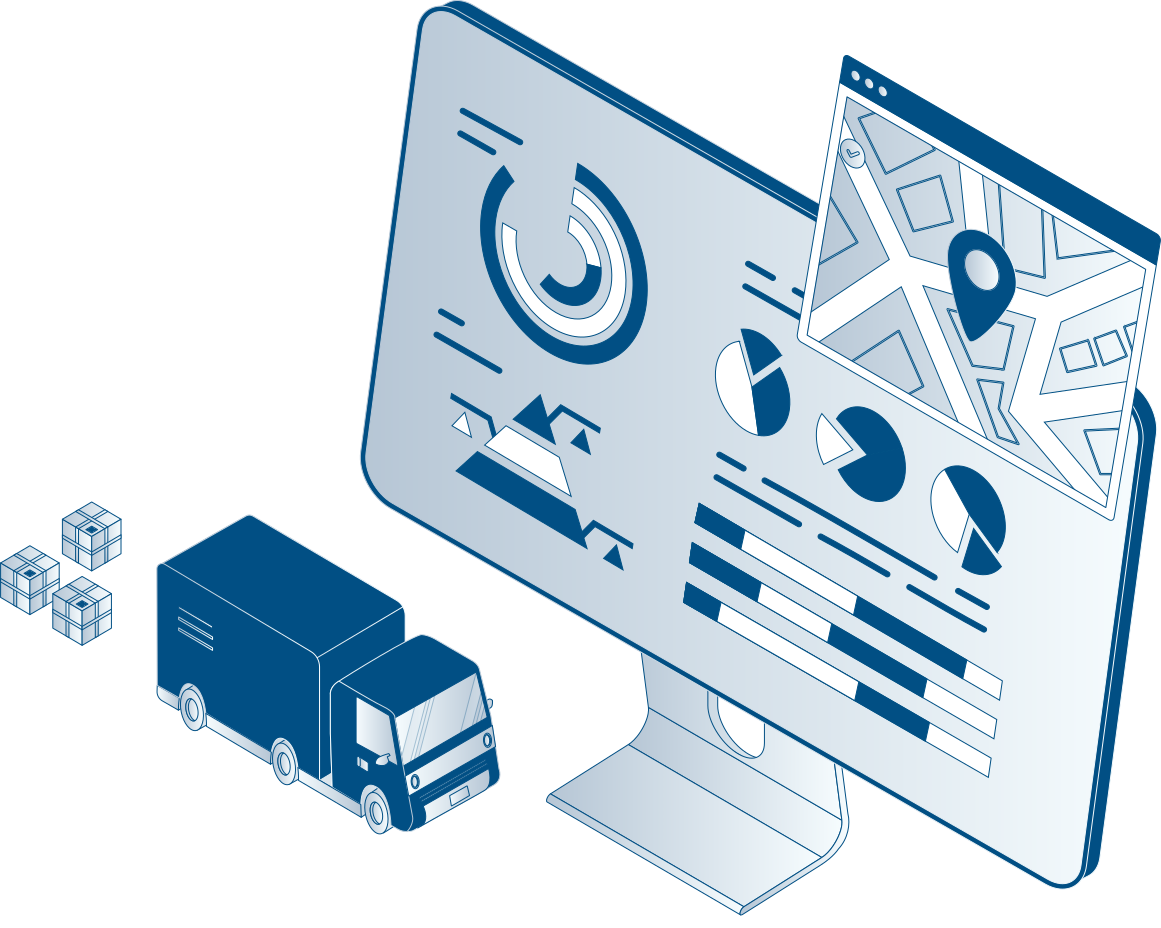
SysGears builds transportation and logistics analytics software for companies that need better control over operational performance, costs, and environmental impact. Our experts develop solutions that consolidate data from fleet management software, warehouse systems, shipment tracking tools, as well as third-party services, giving you a consistent and reliable view of key operational, financial, and sustainability metrics across your logistics operations.
About SysGears
SysGears is a software development company with over 16 years of experience in creating custom software across multiple industries, including transportation and logistics. This background shapes how we approach logistics analytics projects, especially in environments where data is fragmented, systems are heterogeneous, and reporting needs change over time.
Some clients come to us to build an analytics infrastructure from the ground up. Others require our help in improving reporting accuracy, connecting scattered data sources, or modernizing systems that no longer reflect how their business really works. In every case, we focus on delivering solutions that generate reliable insights, evolve with changing workflows, and support efficient, scalable operations.
Challenges in Transportation and Logistics Without Analytics
As per the Grand View Research, the global transportation analytics market size was estimated at USD 12.61 billion in 2024 and is projected to reach USD 43.01 billion by 2030, growing at a CAGR of 23.8%. This growth is driven by the increasing adoption of smart transportation initiatives and advanced traffic management systems, reflecting a broader shift toward data-driven logistics operations and decision-making.
A separate analysis from Bertling Logistics highlights the same shift from another angle: cloud-based systems and data analytics in logistics and transportation are becoming essential for modern logistics, enabling real-time visibility and turning fragmented data into actionable decisions.
In practice, this comes down to a set of very specific problems:

Lack of visibility slows everything down. Logistics data is spread across TMS, WMS, ERP systems, and spreadsheets, making it difficult to see what is happening across operations.
Costs increase without being noticed. Transportation, fuel, warehousing, and labor costs build up through small, repeated inefficiencies.
Planning without forecasting is still guesswork. Demand shifts, delays, and disruptions are constant. Static plans don’t hold under real-world conditions.
Scaling operations exposes weak points. What works at a smaller scale tends to break as operations grow.
Customer expectations outpace operations. Fast, reliable delivery is now a basic requirement.
Sustainability adds another layer of complexity. Reducing environmental impact introduces new variables into logistics planning.
Competition is already data-driven. Data-driven operations are becoming standard, increasing pressure on efficiency and cost control.
Logistics Analytics Solutions We Offer
Modern analytics for logistics and transportation is not a single tool. In fact, it is a set of capabilities that provide visibility and control across different parts of the operation: from fleet efficiency to financial outcomes.

Fleet Performance and Utilization Analytics
Fleet analytics provides a more detailed view of how vehicles perform in real-world conditions. It helps identify inefficiencies that are not obvious at the surface level, such as excessive idle time or underutilized capacity. With the right data in place, teams can track route time, load utilization, and fuel usage. Also, it allows them to detect patterns behind fuel waste and emissions, monitor vehicle condition, and predict maintenance needs.

Route analytics centers on how effectively goods move through the network. It connects delivery performance to cost and timing rather than treating them separately. Typical use cases of this type of analytics include monitoring on-time delivery as well as fulfillment rates, and comparing routes by cost, duration, and reliability. It also uncovers the best ways to adjust routes based on traffic or external conditions. More advanced setups support scenario testing, helping teams evaluate alternatives before making operational changes.

Warehouse and Inventory Optimization Analytics
Warehouse analytics brings visibility into how space and inventory are used. It highlights bottlenecks in storage and handling processes that often go unnoticed. With better insight, companies can improve inventory turnover and storage utilization, optimize picking, packing, and replenishment workflows. Also, with its help, they can anticipate demand for inventory and warehouse labor. This reduces both excess stock and operational bottlenecks.

Safety analytics focuses on identifying operational risks in transportation and warehouse environments. It enables teams to analyze handling conditions for sensitive or hazardous goods, track incidents, near misses, and safety violations, as well as identify recurring issues, including their root causes. The goal is not just reporting incidents, but preventing them through better visibility and pattern detection.

Procurement analytics help control costs and enhance supplier selection by making procurement processes more transparent. It sheds light on spending distribution, purchasing efficiency, and supplier performance and reliability. In addition, it highlights process bottlenecks in procurement cycles. This allows companies to make more informed sourcing decisions and reduce unnecessary costs.

Order and Fulfillment Analytics
Order analytics connects operational execution with customer outcomes. It helps identify where fulfillment processes break down and why. Teams can track order accuracy, cycle time, and return rates. They also can link returns to specific operational factors and identify patterns that affect fulfillment quality. This makes it easier to improve consistency and reduce costly errors.

Financial Visibility and Cost Analytics
Financial analytics brings together operational and financial data to show what actually drives profitability. It allows businesses to break down costs by route, mode, or customer segment. Additionally, it locates inefficiencies and margin leaks, and supports budgeting and financial planning with real data. This is critical for making operational decisions that align with business outcomes.

Customer analytics helps logistics companies understand behavior, expectations, and service performance. With the right data, teams can segment customers by value, behavior, or location. Additionally, they can track satisfaction, retention, and service quality, which helps with adjusting service strategies based on actual usage patterns. This supports both retention and service improvement.

Workforce analytics focuses on how labor is allocated and how teams perform across operations. It equips organizations with the necessary tools to monitor productivity and workload distribution as well as identify drivers of turnover or inefficiency. With its help, teams can also plan staffing based on demand and operational needs. This becomes especially important as operations scale and labor costs increase.
Key Integrations for Analytics in Transportation and Logistics
Analytics software depends on a steady flow of operational data. In transportation and logistics, that data comes from multiple systems, each handling a specific part of the workflow. By connecting these systems, analytics can reflect how operations really run across the entire chain rather than relying on isolated, disconnected datasets.
Transportation Management Systems
TMS provides shipment-level data, such as routes, schedules, carrier assignments, and delivery status. This information powers dashboard tracking with a continuous record of how transportation plans are executed on the ground, including deviations from planned routes and timelines.
Warehouse Management Systems
WMS generates detailed data on inventory movement, storage locations, and order processing steps. Integration at this level captures how goods are received, stored, picked, and dispatched. This allows analytics to work with real operational throughput rather than aggregated summaries.
Fleet and Telematics Tools
Fleet management platforms and onboard telematics supply real-time data on vehicle location, usage patterns, fuel consumption, and driver activity. This data is typically streamed continuously, making it one of the primary inputs for time-sensitive analysis and monitoring.
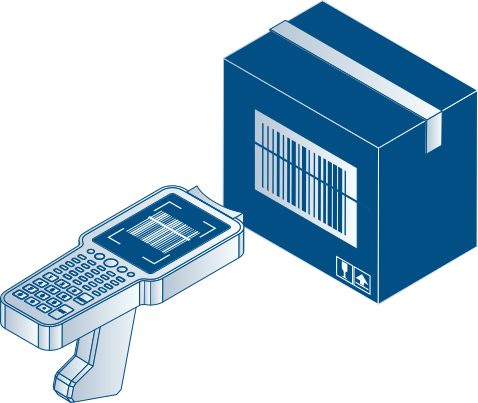
Inventory Management Software
Inventory systems track stock levels, product movement, and replenishment cycles across locations. When integrated, they provide a consistent view of how inventory changes over time and how it aligns with incoming and outgoing shipments.
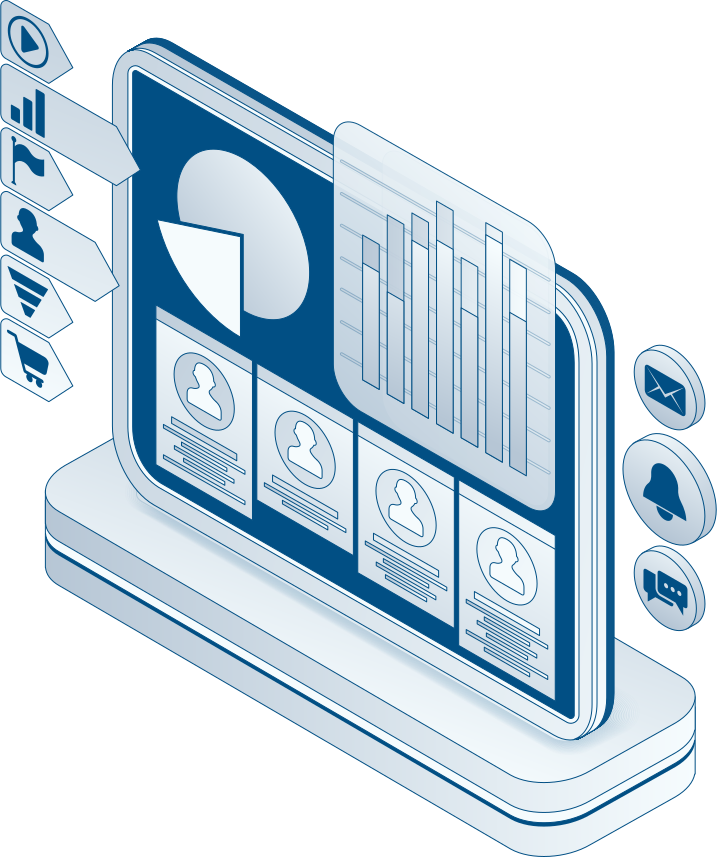
Customer and Order Management Platforms
CRM and customer-facing portals capture order data, delivery preferences, and service interactions. This layer connects operational execution with customer-facing outcomes, enabling analytics to link fulfillment performance directly to real‑world customer behavior.
ERP and Financial Systems
ERP software provides financial context, including cost structures, procurement data, and revenue attribution. Financial systems, on the other hand, complement this by managing accounting, invoicing, and broader financial reporting. Integration with these systems enables operational events like shipments or warehouse activity to be directly tied to financial results.
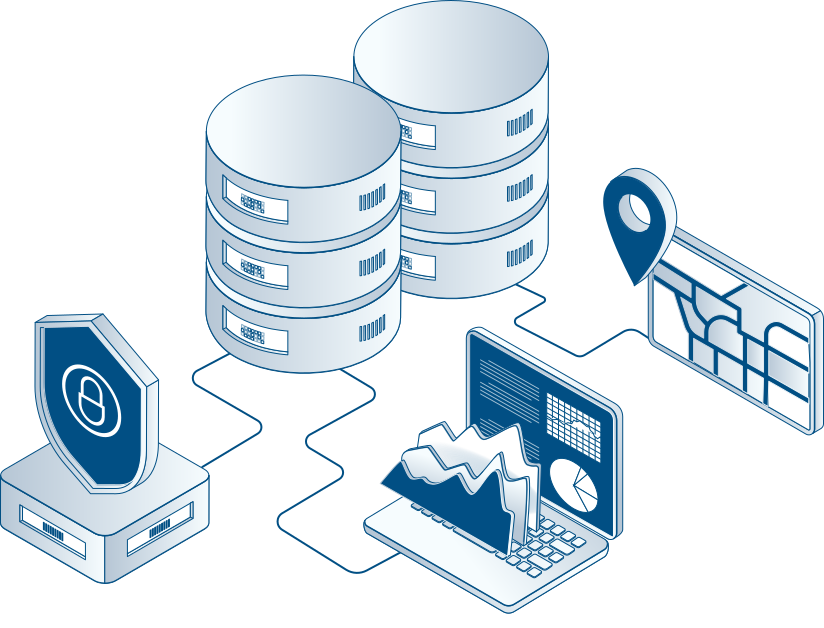
External Data Inputs
External data sources introduce variables that are not controlled within internal systems. Among them are traffic conditions, weather updates, as well as geographic data, which influence how logistics operations unfold. Integrating these inputs allows analytics to account for external disruptions and fixed spatial constraints when analyzing and optimizing operations.
Our Logistics Analytics Development Process
At SysGears, we follow a structured yet flexible process for building logistics analytics solutions. Our goal is to deliver software that mirrors real operational workflows, integrates with existing systems, and performs reliably in day‑to‑day logistics environments.
Initial Discussion
We begin with a brief introductory call to understand your operations, current systems, in addition to the challenges you want to address with analytics. At this stage, our specialists find it important to get a clear sense of your business context, priorities, and expectations. This helps us assess feasibility, outline a high-level scope, and define the right direction for further analysis. Once we agree on goals and next steps, we formalize cooperation with a service agreement and an NDA.
Discovery and Requirements Analysis
During discovery, we analyze how data is generated and used across logistics operations. This includes how information flows between transportation, warehouse, fleet, and business systems, as well as where gaps, delays, or inconsistencies occur. Our professionals also examine how different roles interact with data, since operational teams and management require different levels of visibility. The outcome is a clear understanding of what the analytics system needs to support real decision-making, rather than isolated reporting.
Business and Technical Specification
At this stage, our BA specialists translate the findings from the discovery phase into a structured technical design. This includes defining key performance indicators, mapping data entities that support business analytics in transportation and logistics, and outlining how systems will interact within the analytics environment. Also, we assess integration requirements across transportation, warehouse, fleet, and enterprise platforms, taking into consideration cases where legacy systems require custom connectivity. The goal is to ensure that business expectations are in line with what can be realistically implemented and scaled.
Team Setup
Once the scope is defined, we assemble a dedicated team matched to project complexity. Logistics analytics work typically requires expertise in distributed systems, data integration, and real-time or near real-time processing. The team structure remains flexible and can evolve as new requirements or data sources emerge during development.
Design of Analytics Interfaces
Our designers create interfaces based on how logistics teams actually use data. We focus on role-specific views for dispatch, warehouse operations, fleet management, and leadership. Each view is structured for fast interpretation and decision-making. Wireframes or prototypes are used to validate usability and ensure the design meets expectations before development begins.
Iterative Development
Our developers follow an iterative cycle during which functionality is built progressively. Work typically begins with integrating core logistics systems, followed by building unified data models and implementing analytics logic. Additional data sources and use cases are introduced gradually as the system evolves. This approach is essential because data structure and quality often vary significantly across logistics environments and cannot be fully standardized upfront.
Quality Assurance
Our QA specialists run tests throughout the entire development process. In logistics analytics, the correctness of data interpretation is of immense importance. Hence, our testing process is focused on data consistency, metric accuracy, system performance, as well as integration reliability under real data volumes. Even small inconsistencies can affect operational decisions, so validation is continuous.
Ongoing Support and Evolution
After deployment, logistics operations continue to evolve as new systems, routes, and external providers are introduced. Consequently, the analytics layer must evolve with them. Ongoing support we offer comprises the following: integration of new data sources, adjustment of analytics models, and optimization of performance as data volume grows. The goal is to keep the system in line with operations over time, rather than turning it into a static reporting infrastructure.
Transportation Analytics in Practice

SysGears worked with a passenger transportation company in order to build a taxi management system aimed to support driver operations, fleet oversight, and business analytics within a single platform. The solution digitizes key processes like tax and salary calculation, vehicle assignment, as well as performance tracking, helping administrators, drivers, and fleet managers make informed decisions.
Our team of skilled engineers handled end‑to‑end development, including product vision refinement, system architecture, backend and frontend implementation, quality assurance, and continuous project management as the platform evolved and scaled toward a future SaaS offering.
Among the key solutions delivered are:
- Automated administrative workflows for tax reporting and driver payments, minimizing manual effort and errors;
- Transparent analytics dashboards for drivers showcasing earnings, trip history, and performance, letting them understand how their work impacts revenue;
- Smart fleet management tools enabling administrators and fleet owners to assign vehicles efficiently via an interactive map and optimize utilization;
- Revenue prediction functionality for fleet managers, helping them estimate profitability based on vehicle type, availability windows, and expected utilization;
- A unified web and mobile platform (React, React Native, Scala, Play, PostgreSQL) designed for scalability and future SaaS deployment;
- QA processes focused on correctness of financial and tax calculations, integration consistency, as well as usability across web and mobile interfaces.
Client Testimonials on Our Services

5.0

“Their level of engagement, long-term mindset, and solid technical expertise make them a really reliable partner.”
Anastasiia Chala
CMO, Stormotion
5.0
“SysGears has delivered new functionality on time for each iteration, achieving user satisfaction with the updates. The team completes tasks promptly, is attentive to the client’s needs and willing to scale their services, and proactively suggests solutions while maintaining clear communication.”
Jane
Client Success Manager, Custom Software Development Company
5.0
“This company has been nothing but transparent and helpful in the development process.”
Moni Ali
Founder & CEO, Web & App Dev Company

Ready to build your logistics analytics solution? SysGears can help you develop a custom logistics analytics platform tailored specifically to your operations.
FAQ
What is logistics analytics software, and how is it different from the reporting tools built into our TMS or ERP?
Logistics analytics software aggregates operational data from multiple systems and turns it into cross-functional insights. Unlike TMS or ERP reporting, which is limited to system-specific data, it connects shipments, carriers, routes, as well as costs into a unified dataset so you can analyze performance end-to-end rather than in isolation. This allows you to understand not just what happened, but why it happened across your logistics network.
At SysGears, we build logistics analytics solutions that unify fragmented operational data into a structured, consistent data framework, enabling companies to move from isolated reporting to overall visibility across their logistics operations.
How do we measure profitability from a custom-built transportation analytics solution?
Profitability from a custom-built transportation data analytics solution is best measured by its tangible operational impacts. Key indicators include reduced transportation costs per lane, improved asset utilization, fewer empty miles, better carrier rate decisions, and higher on-time delivery performance, which reduces penalties and rework. A well-built analytics layer helps you attribute margin changes to specific operational drivers instead of high-level aggregates.
Our team designs transportation analytics solutions that connect cost, performance, and operational data, allowing organizations to clearly trace profitability drivers and identify where optimization has the highest financial impact.
Is custom logistics analytics only viable for large enterprises, or does it make sense for mid-sized 3PLs and freight operators?
Custom logistics analytics is not limited to enterprises. Mid-sized 3PLs and freight operators often benefit from logistics analytics even more because they often operate with fragmented tools, manual reporting, and limited cross-system visibility. A custom solution helps unify existing data without requiring a full replacement of current systems.
Our developers build logistics analytics solutions for both mid-sized and enterprise-level logistics companies, focusing on incremental integrations that improve system visibility without disrupting existing operations.
We already use Power BI or Tableau. Why would we need a custom logistics analytics layer on top of that?
BI tools are effective for visualization, but they rely on the quality and consistency of underlying data. In logistics environments, data is often fragmented across multiple systems with different definitions for key metrics like delivery time, cost per shipment, or utilization. A custom analytics solution standardizes this data before it reaches BI tools, ensuring that dashboards reflect operational reality rather than disconnected sources.
We build logistics data analytics layers that serve as a single source of truth for BI tools like Power BI or Tableau, ensuring that reporting is based on consistent, validated logistics data.
What’s the biggest cost driver in logistics analytics development: data volume, integrations, or real-time processing requirements?
The primary cost driver in logistics analytics development is integration complexity. Specifically, the number of systems involved and the inconsistency of their data structures. Logistics environments typically combine TMS, ERP, fleet systems, warehouse platforms, and external carrier APIs, all of which define operational metrics differently. Aligning these aspects is more complex than handling data volume or real-time processing.
Our specialists focus on designing integration-first logistics analytics architectures that normalize data across systems early in the pipeline, reducing long-term complexity and maintenance costs.
We have years of shipment, carrier, and route data sitting in spreadsheets and legacy systems. Is that enough to build something useful?
Yes, historical shipment, carrier, and route data is typically sufficient to build valuable logistics analytics, provided it includes consistent details on key operational elements, even if stored in spreadsheets or legacy systems.
At SysGears, we help logistics companies transform legacy and fragmented operational data into structured analytics systems that reveal performance patterns and support data-driven decision-making.
Boost your business with custom software
Tell us about your business needs and we’ll suggest a solution
Thank you!
We have received your request and will get back to you within 1 business day.


