
AI Agent Development Services
SysGears provides custom AI agent development for multi-step workflow automation, building agents that work with your existing data and perform authorized actions through connected systems. We design each solution around your business and integration requirements, defining the level of agent autonomy based on the actions the system needs to perform.
Engineering Expertise for AI Agent Development
As an AI Agent Development Company, SysGears develops AI agents that can work with business data, use connected tools, and carry out multi-step workflows within defined permissions and controls. Depending on the project, we implement RAG-based knowledge retrieval, memory and context management, human-in-the-loop mechanisms, and multi-agent architectures.
However, AI expertise is only one part of the engineering work behind an AI agent. At SysGears, we also draw on experience gained through developing web and mobile applications, building data-processing functionality, and integrating software systems for enterprises, SMBs, and startups across different domains. This broader engineering background helps us build autonomous AI agents that integrate with existing systems and operate within established business processes.
- 16+ years of experience in custom software development
- 350+ corporate customers across 6 continents
- 110+ software development experts
- 40+ ongoing projects
Benefits of AI Agents for Your Business

Faster Process Execution
Minimize delays caused by routine handoffs and other activities that would otherwise wait for employee input. Automating these intermediate steps can shorten the time between receiving a request and completing the corresponding process.

Lower Operational Costs
Reduce the cost of repetitive operations by automating tasks that consume employee time at different stages of the process. AI agents can handle routine execution across multiple cases, helping minimize the resources spent on processing each one.

Broader Automation Coverage
Extend automation to processes that are difficult to cover with fixed rules alone. AI agents for workflow automation can work with variable inputs and use context to choose the next step from a range of available options.

Greater Operational Capacity
Handle growing or fluctuating request volumes without increasing staffing at the same rate. AI agents can be deployed to handle multiple tasks concurrently, helping teams maintain throughput as demand changes.

More Unified Use of Business Data
Bring relevant data from different business systems into a single workflow. AI agents can access authorized sources and use the retrieved data when completing tasks across connected applications.

Easy Access to Software Functionality
AI agents can give employees or customers simpler ways to access software functionality and complete tasks across connected applications. When a conversational interface fits the use case, then users can express what they need in natural language instead of navigating multiple screens or systems.
AI Agent Development Services We Provide

AI Agent Consulting and Strategy
Determine whether an AI agent is the right solution for the process you want to automate and what it would take to implement it with our AI agent consulting services. Our team assesses your workflows, business and technical requirements, available data, and existing software to identify suitable use cases and evaluate their feasibility. Based on the findings, we help define the solution architecture, technology stack, and development roadmap.

AI Agent PoC and MVP Development
Validate an AI agent concept before committing to full-scale development. SysGears can build a PoC to test technical feasibility and key assumptions or develop an MVP with core agent workflows needed for an initial release. This gives you a clearer basis for deciding how to proceed with the project and approach further development.

Custom AI Agent Development
Build an AI agent around a business workflow or product idea, tailored to your domain and operational requirements. Depending on the use case, we develop agents that can interpret context, plan and execute multi-step tasks, and interact with connected tools and systems. The solution can use a single-agent or multi-agent architecture based on the roles and coordination needed. The level of autonomy is defined for each specific case, with human approval for actions that presuppose additional oversight.

AI Agent Integration
Connect AI agents to the software and data required for their workflows. Our engineers integrate agents with existing applications, databases, APIs, and third-party services so they can retrieve relevant information and perform authorized actions. Where appropriate, we can develop MCP servers or connect AI applications to the existing ones, providing standardized access to relevant tools and resources.

Agent QA and Evaluation
Test both the software functionality and how the agent behaves when interacting with connected systems. Alongside software testing, SysGears evaluates agent outputs, action selection, tool use, and workflow execution across expected scenarios, edge cases, and failures. This helps identify incorrect or unsafe behavior and reduce the risk of such issues occurring in production.

AI Agent Maintenance and Enhancement
Adapt your AI agent as the software, integrations, and business processes around it change. Our team can address identified issues, update integrations and agent workflows, and improve existing functionality. As new requirements emerge, we can also extend the agent with additional capabilities or connections to other systems and data sources.

Turn your AI agent idea into an effective solution with SysGears!
AI Agent Development Solutions We Build

Workflow Automation Agents
Build AI agents for workflow automation where handling multiple steps, systems, or variable inputs requires the software to determine what to do next based on context. SysGears develops workflow agents that can process incoming information, select among authorized actions, and use connected tools to move tasks forward with less manual involvement. Depending on the solution architecture, these agents can contribute to long-running processes, respond to events, coordinate tasks across systems, and involve employees when approval or escalation is required.

Conversational AI Agents
Enable customers and employees to interact with your software through natural language. We develop conversational AI agents that can answer questions, access relevant business information, and perform permitted actions through connected systems. They can reinforce customer support, assist customer self-service, and provide internal employee assistance, with text- or voice-based interaction depending on the application.

Knowledge and Research Agents
Make it easier to find, process, and work with information spread across different sources. We develop knowledge and research agents that can search internal or external sources, work with documents, and accurately analyze the information they retrieve. Depending on the task, they can use search and RAG techniques to provide relevant information as context for generation or analysis.

AI Copilots and In-Product Agents
Bring AI assistance directly into the applications your employees and customers already use. We build copilots and embedded agents that use relevant application context, assist with specific tasks, and interact with permitted application functionality when needed. Depending on the product, they can guide users through workflows, help them work with information, or assist with tasks within the application.

Multi-Agent Systems
Divide responsibilities between specialized agents when different parts of a workflow benefit from separate roles, contexts, or toolsets. SysGears develops multi-agent systems where individual agents can perform specific functions, exchange information, and work together through the selected orchestration approach. Depending on the architecture, agents can operate in supervisor-and-worker structures, delegate tasks, and execute work sequentially or in parallel.
AI Agent Capabilities We Implement

Reasoning and Planning
Enable agents to interpret the context available for a task and plan how to work toward a defined goal. As new information becomes available, the agent can adjust its approach. Its behavior is shaped by the instructions, tools, and constraints defined for the workflow it’s integrated into.

Autonomous Task Execution
Allow agents to carry out multi-step tasks with a level of autonomy appropriate to the use case. Depending on the required controls, autonomous AI agents can perform authorized actions without manual intervention or involve a person at defined stages of the process.

Tool Calling
Give agents access to specific software functionality they need to complete tasks. Agents can call APIs, invoke application functions, access data through controlled interfaces, or use purpose-built tools, with available actions defined according to solution requirements.

Memory and Context Management
Connect AI agents to the software and data required for their workflows. Our engineers integrate agents with existing applications, databases, APIs, and third-party services so they can retrieve relevant information and perform authorized actions. Where appropriate, we can develop MCP servers or connect AI applications to the existing ones, providing standardized access to relevant tools and resources.

Knowledge Retrieval and RAG
Connect agents to documents, knowledge bases, and other information sources they need to work with. Search and RAG mechanisms can provide relevant information as context for answering questions, analyzing material, or completing knowledge-intensive tasks.

Human-in-the-Loop Workflows
Add human review or approval at predefined points where an agent is not permitted to proceed independently. These checkpoints can be applied to sensitive actions, exceptional cases, or other situations that require additional oversight before the workflow continues.
Technologies We Use for AI Agent Development
Frontend
React
Next.js
React Native
Expo
Redux
MobX
Apollo Client (GraphQL)
Vite
JavaScript/TypeScript Backend Ecosystem
Node.js
Express
NestJS
Apollo Server (GraphQL)
WebSockets
BullMQ
Redis
Swagger
Sentry
TypeORM
Prisma
Mongoose
Python Backend Ecosystem
FastAPI
Django/DRF
Flask
Celery
SQLAlchemy
Pydantic
Pandas
NumPy
Scala Backend Ecosystem
Play Framework
http4s
Akka / Pekko
ZIO
Cats
FS2
Slick
Quill
Doobie
Caliban
AI Frameworks
LangChain
LangGraph
Pydantic AI
AI SDK
BeeAI
Mastra
LlamaIndex
Langfuse
AI Platforms
OpenAI
Anthropic
Google Gemini
VertexAI (Gemini Enterprise Agent Platform)
promptfoo
Voice AI
Vapi
OpenAI Whisper
ElevenLabs
OpenAI
Realtime API
Vector Databases
Pinecone
pgvector (PostgreSQL)
Qdrant
Cloud / Infrastructure
AWS
GCP
Azure
Docker
Autonomous AI Agents Across Industries
Healthcare
AI agents can support administrative workflows and information access across healthcare software systems, reducing the manual work involved in routine processes.
- Patient and staff assistance
- Healthcare information and document retrieval
- Scheduling and administrative task automation

Ecommerce and Retail
In ecommerce and retail, AI agents can assist customers and employees with tasks that require information or actions across online platforms and internal business systems.
- Product discovery and customer assistance
- Order and return support
- Inventory-related and operational task automation

Fintech
Financial teams can use AI agents to process information, investigate cases, and carry out multi-step operational tasks within defined permissions and controls.
- Financial document processing
- Transaction review and case assistance
- Operational and compliance-related task support

Insurance
AI agents can support insurance operations that involve working with policyholder information, documents, and data from connected business systems.
- Claims intake and document processing
- Policyholder support
- Underwriting information and case review assistance
Transportation and Logistics
AI agents can support transportation and logistics operations where changing shipment data, exceptions, and coordination between multiple systems require ongoing attention.
- Shipment tracking and exception management support
- Logistics document processing
- Cross-system operational workflows

Travel and Hospitality
AI agents can assist travelers and hospitality staff with tasks that require access to booking information, service details, and other connected business systems.
- Travel planning and booking assistance
- Guest request handling
- Internal service coordination

Telecom
Telecom companies can use AI agents to support customer service and operational tasks that depend on information from multiple software systems.
- Customer support and self-service
- Troubleshooting assistance
- Internal knowledge retrieval
Manufacturing
AI agents can help manufacturing teams work with technical and operational information and automate business processes handled through software systems.
- Internal knowledge assistance
- Procurement and administrative task automation
- Document processing and analysis

Investment
Investment teams can use AI agents to research, organize, and analyze information from authorized internal and external sources.
- Market and company research
- Financial data analysis and synthesis
- Portfolio monitoring and reporting support

Media and Entertainment
AI agents can support content and production workflows that involve researching information, working with digital assets, or accessing internal knowledge.
- Content and topic research
- Metadata and content management workflows
- Content archive and knowledge retrieval
Our Experience with AI-Powered Software
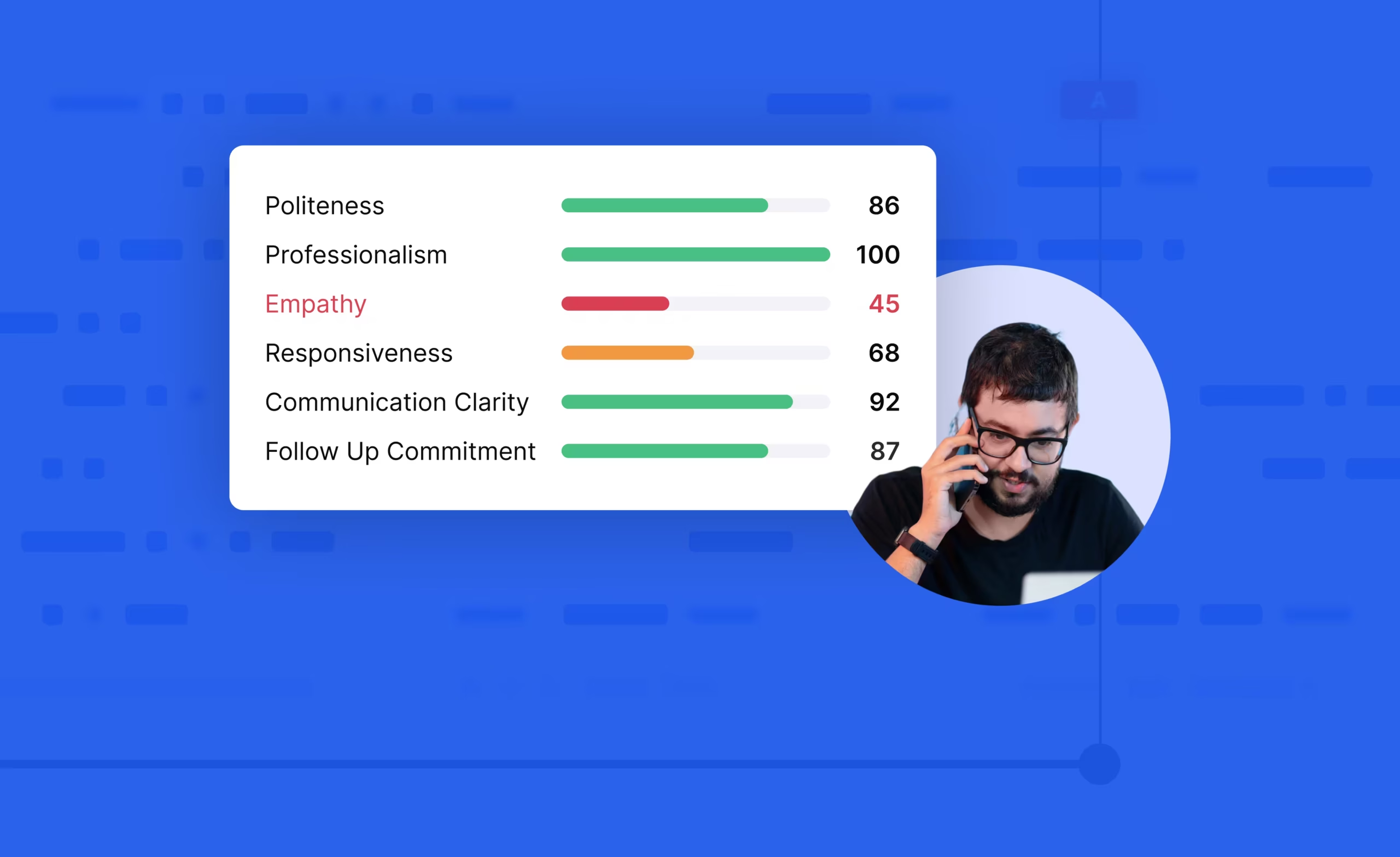
Our engineers have worked on AI-powered software across different industries and use cases, from digital healthcare to eLearning. These projects demonstrate our experience with the broader engineering work involved in building AI-enabled products, including application development, system integration, data processing, and modernization. Explore selected case studies to see this work in practice.


What Our Clients Say

5.0

“SysGears exhibits great flexibility, adaptability, and receptiveness towards the client’s needs. Should the client consider expanding their team, they have the ability to immediately provide highly qualified engineers that can integrate well with internal development staff.”

Alex Kushnir
Solution Architect, Sestra Systems
5.0
“SysGears really took the time to understand our needs and established an efficient approach for our project. They were genuinely invested in the project’s overall success, ensuring that their efforts aligned with our vision and goals.”
Nathan Leyton
CTO, Call Handling Services Ltd
5.0
“The overall team was great, the culture of being helpful and going out of their way to make sure we were taken care of. The team members that were assigned to us and worked with were really amazing, and it felt as if they were part of our team.”

Sohrab Tellaie
Founder, omni.day

5.0
“SysGears has been an amazing partner in getting my project off the ground. Not only are they extremely technically skilled, they have excellent procedure and are able to think critically about the problems I’ve been addressing.
I’ve been working with them for about 6 months now, and look forward to their help as we gain traction, now that we’ve successfully delivered a beta version of the product.
They went above and beyond to understand the vision, and foresaw implementation complexities well in advance.”
Joseph Corey
Founder & CEO, Subspace
Why Choose SysGears as Your AI Agent Development Company

Business and Technical Feasibility First
We assess the potential business value and technical feasibility before recommending an agentic solution. Our team examines the target process, business objectives, available data, existing technical environment, implementation risks, and expected costs to help you determine where AI can provide practical value and where traditional automation may be sufficient.

Quality Built Into Development
At SysGears, quality management starts with requirements and continues through development and release. Our project teams work to identify unclear requirements, technical risks, and software issues as the solution evolves, with quality considered at every stage. For AI agent projects, we put particular emphasis on validating agent behavior, including its outputs, action selection, and use of connected tools.

Security Designed for AI Agents
Giving an AI agent access to business data or software functionality introduces security considerations that need to be addressed at the application level. At SysGears, we limit agents to the permissions and tools required for their tasks, restricting access to functionality outside their intended scope. Where sensitive operations are involved, such as changing permissions or approving transactions, human confirmation can remain part of the process. We also account for AI-specific threats, including prompt injection, when designing the security controls around the solution.
Transparent Project Delivery
Throughout custom AI agent development, SysGears keeps you informed about project progress, current priorities, and potential issues that may affect delivery. Regular communication, timely reporting, and demo sessions give your team visibility into project progress, upcoming priorities, and the current state of the solution. This also helps surface changes in scope, schedule, or budget early, so they can be discussed before they become larger project risks.
Choose the Right Collaboration Model for Your AI Agent Project
Full-Cycle Development
Entrust your AI agent project to SysGears from initial technical planning to development, integration, testing, and release. Our AI agent development team can design the AI agent architecture, build the required functionality, connect the solution to your existing systems and data sources, and implement the necessary access controls and safeguards. After launch, we can also provide maintenance and further enhance the solution as your requirements change.
Dedicated Teams
Get a dedicated group of specialists covering the roles your AI agent project requires. Depending on the scope, SysGears can provide AI and software engineers, QA specialists, designers, and other experts who work exclusively on your solution and collaborate as one team throughout the engagement.
Team Augmentation
Expand your existing team with AI specialists who bring the expertise or development capacity you need. Our experts join your established processes and work alongside your engineers on specific areas of the AI agent solution, such as agent functionality, backend development, integration, or QA.

Ready to move your AI agent beyond the concept or pilot stage? Work with SysGears to build a solution around your workflows, data, and existing software.
Other AI-Related Services We Offer
Depending on where you are in your AI journey, you may need support beyond AI agent development. SysGears can help you evaluate an AI use case, validate an idea with an MVP, build AI-powered software, or develop a conversational solution.
Learn More About Building AI Agents with MCP
MCP for Business: Building Adaptable AI Agents
Model Context Protocol (MCP) provides a standardized way to connect AI agents with business data, tools, and existing software capabilities. In this article, our expert explores where MCP fits into AI agent architecture, how it works with existing APIs and access controls, and how it can support more flexible AI workflows.
Software Engineer

FAQ
What is an AI agent, and how is it different from an AI chatbot?
An AI agent is a software system that uses artificial intelligence to work toward a defined goal, select actions based on the available context, and interact with tools or other systems when needed. For example, an agent could process a request to update a customer account by retrieving the required data and making the permitted change through a CRM API.
An AI chatbot, by contrast, focuses on communicating with people in natural language. For instance, it can answer questions or help users find information.
At SysGears, we can develop both autonomous AI agents and context-aware AI chatbots depending on what your software needs to accomplish. We can also combine a conversational interface with agentic capabilities when users need to communicate with a system in natural language and have it perform authorized actions on their behalf.
What does AI agent development cost?
AI agent development cost depends on the complexity of the workflows the agent needs to handle, the systems it needs to integrate with, its level of autonomy, and the required security and testing. As a general benchmark, European software vendors working on an hourly basis, SysGears among them, typically charge from $35 to $80 per hour for software development services. Additional running costs may include model API usage, cloud infrastructure, and other third-party services. After reviewing your requirements, we can provide a tailored project estimate.
Which business processes are suitable for AI agent automation?
An AI agent for workflow automation can be suitable for multi-step processes where some decisions depend on variable or unstructured information and cannot be fully defined by fixed rules. Examples include support request resolution, insurance claim intake, IT incident triage, and invoice exception handling, among others. At SysGears, we analyze the target process before proposing agentic automation to make sure an AI agent is the optimal solution.
How do you reduce the risk of an AI agent taking incorrect actions in production?
Production agents should not have unrestricted access to business systems. SysGears designs AI agent architecture that limits the agent to specific tools and permitted actions, validates inputs and outputs at the application level, and requires human approval for high-impact operations, such as issuing refunds or changing account permissions.
Before deployment, we test the agent against expected workflows, edge cases, and failure scenarios in order to identify cases where it selects the wrong action, uses a tool incorrectly, or produces an invalid result. After release, our team can provide maintenance services to address newly identified issues and adjust the agent as its workflows or business requirements change.
Should we use a single AI agent or a multi-agent system?
Single agents work well when tasks belong to the same workflow and do not require separate roles or reasoning contexts. Take customer support: one agent can understand the request, look up the relevant account details, and carry out an approved action with the tools available to it.
Multi-agent systems can be useful when the workflow is easier to divide between specialized roles. Consider a research task: one agent could gather and assess sources, while another analyzes the evidence. A coordinating agent may then bring their outputs together. Each agent works with a more focused scope, but the system now has to exchange information and coordinate work between them. Multiple agents, therefore, introduce additional orchestration, testing, latency, and cost.
Our team assesses your use case and technical requirements to determine whether a single-agent or multi-agent approach is more appropriate for your solution.
Can an AI agent integrate with our existing software and data sources?
Yes. AI agents can work with existing business applications, databases, and third-party services through APIs and other interfaces those systems provide. Depending on the use case, the agent may need read-only access to retrieve information or permission to perform specific actions through controlled interfaces.
For AI agent integration, SysGears assesses the available APIs and interfaces, authentication and authorization mechanisms, data flows, and access requirements before connecting an agent to your existing systems.
Boost your business with custom software
Tell us about your business needs and we’ll suggest a solution
Thank you!
We have received your request and will get back to you within 1 business day.


